
Production floors are rarely static. Lines expand, operators need access, safety paths must remain clear, and equipment requires regular servicing. In these environments, fixed conveying solutions often become obstacles rather than enablers. A retractable conveyor addresses this challenge by allowing sections of a conveyor line to extend when needed and retract when clearance, access, or flexibility is required.
This type of system is widely adopted across manufacturing, packaging, and distribution environments where throughput cannot be sacrificed for accessibility. By integrating controlled movement into conveyor design, retractable systems support operational continuity and adapt to changing floor-level demands.
What Is a Retractable Conveyor System?
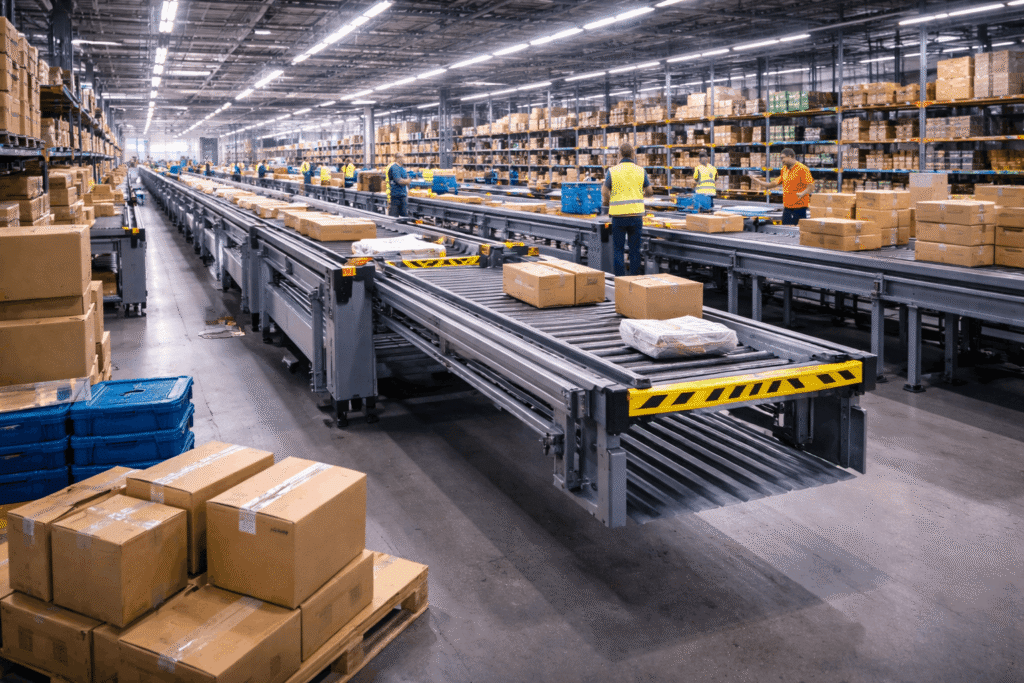
A retractable conveyor is a conveyor section engineered to telescope, pivot, or slide away from its operating position. When retracted, it creates an open space for personnel, equipment, or product flow. When extended, it resumes normal conveying operations without manual intervention.
These systems are commonly paired with belt conveyors, tabletop chain conveyor layouts, and modular transfer sections, depending on the application.
Key Operational Problems Retractable Conveyors Solve
Retractable systems solve several recurring operational issues, including blocked walkways, restricted access to workstations, and downtime caused by rigid conveyor layouts. They also improve safety by reducing the need for workers to climb over or walk around fixed conveyor frames.
1. Dock Door Loading and Unloading Operations
Loading docks often require conveyors to bridge gaps between trailers and building interiors. Retractable conveyors extend into trailers during loading and retract when doors close, keeping dock areas clear between shipments.
2. Packaging Lines Requiring Operator Access
Packaging lines frequently require operators to adjust cartons, change materials, or clear minor jams. Retractable conveyor sections allow fast access without shutting down upstream or downstream equipment.
3. Assembly Lines With Manual Workstations
Manual assembly stations benefit from retractable conveyors that allow parts to be installed or inspected. Retractable sections maintain material flow while accommodating hands-on processes.
4. Robotic Cells and Automated Equipment Zones
Robotic work cells require precise access control for safety and maintenance. Retractable conveyors isolate the cell during operation and provide unobstructed access when robots are offline or serviced.
5. End-of-Line Packaging and Palletizing Areas
At the end of production lines, flexibility is critical. Retractable conveyors support pallet changes, stretch wrapping access, and equipment maintenance without disrupting upstream flow.
6. Quality Control and Inspection Stations
Inspection points often require products to pause or divert temporarily. Retractable conveyor sections create controlled access zones without adding permanent obstructions to the line.
7. Multi-Lane Conveyor Merging and Diverting Points
Systems that use ARB Conveyors or dynamic lane routing benefit from retractable sections at merge points. These sections simplify lane isolation during adjustments or troubleshooting.
8. Maintenance-Heavy Conveyor Sections
Certain conveyor segments experience higher wear due to load type or environment. Retractable designs allow maintenance teams to service components quickly without dismantling surrounding equipment.
9. Facilities With Limited Floor Space
In compact facilities, floor space is a constant constraint. Retractable conveyors help maintain clear aisles and emergency access paths while preserving conveying capacity when needed.
10. Temporary or Reconfigurable Production Lines
Facilities that run seasonal products or frequent changeovers rely on layouts that adapt quickly. Retractable conveyors support reconfiguration without major structural changes.
11. Safety-Critical Walkways and Cross-Aisles
Safety standards often require clear pedestrian paths across production areas. Retractable conveyor sections create compliant cross-aisles without interrupting normal operations.
Design Considerations for Retractable Conveyor Applications
Effective retractable systems require precise alignment, robust actuation mechanisms, and reliable controls. Integration with surrounding conveyors ensures smooth transitions and consistent product handling.
When a Retractable Conveyor Is the Right Choice
Retractable conveyors are ideal when access, safety, and flexibility are as critical as throughput. Operations that undergo frequent adjustments, inspections, or space constraints benefit measurably from this approach.
Flexibility Without Compromising Throughput
Modern production environments demand solutions that adapt without slowing output. Retractable conveyor systems provide controlled flexibility while preserving flow, safety, and efficiency. Conovey designs engineered conveyor solutions that balance operational access with performance requirements.
Connect with Conovey to implement custom built conveyors that align with real-world production challenges and long-term facility goals.