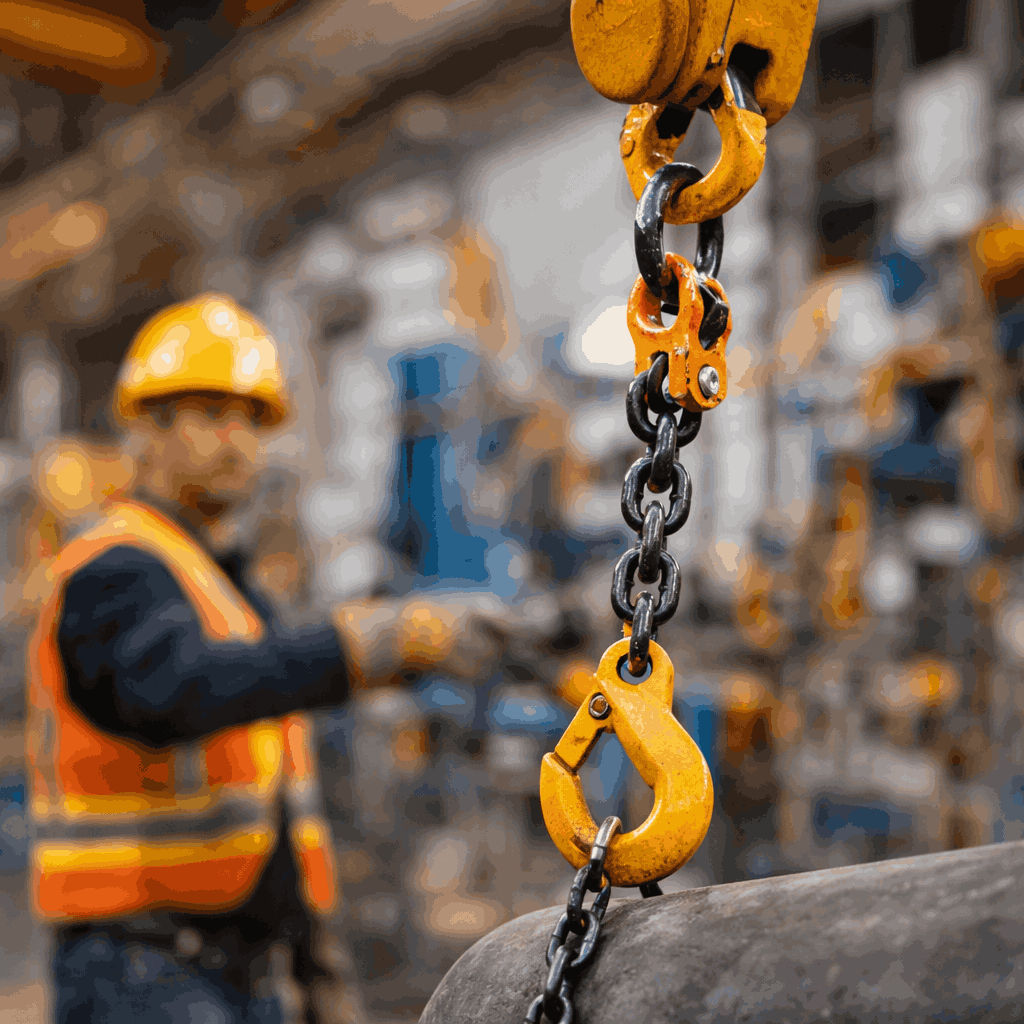

In overhead lifting, simplicity often delivers the most reliable results. While multi-leg chain slings offer balanced load distribution for complex lifts, single leg chain slings remain a core component in many industrial rigging setups. Their straightforward configuration allows for efficient vertical lifts and controlled positioning, particularly when loads have a clearly defined lifting point.
However, simplicity does not eliminate risk. Understanding capacity limits, hardware compatibility, inspection requirements, and correct applications ensures that 1 leg chain lifting slings perform safely under overhead conditions.
Rated Capacity and Angle Limitations
The first factor to evaluate before using a one leg chain sling is rated capacity. The Working Load Limit represents the maximum load the sling can safely support under vertical lifting conditions.
Single-leg slings are most effective in straight vertical lifts. Unlike multi-leg slings, they do not distribute force across multiple attachment points. Any deviation from vertical alignment introduces side loading and increases tension on the chain.
Lift angles significantly impact capacity. When the load is not lifted vertically, the effective tension exceeds the rated limit. This is why single-leg slings should not be used in angled configurations unless specifically engineered for that purpose.
Before lifting, operators must verify the sling’s WLL, confirm vertical alignment, and ensure the load weight remains within the rated capacity.
Proper Hardware and Hook Pairing
The effectiveness of single leg chain slings depends on compatible hardware. Master links must fit securely within the crane hook without excessive movement. Hooks at the load end should match the lifting point, whether that is a lifting lug, shackle, or eye bolt.
Hook type selection matters. Self-locking hooks provide additional security during overhead lifts by preventing accidental disengagement. Standard hooks should be equipped with properly functioning latches where required.
All hardware components must match or exceed the sling’s rated capacity. Using under-rated shackles or mismatched connectors introduces weak points that compromise system integrity.
Chain Grade and Wear Inspection
Chain grade directly affects lifting performance. Alloy grades such as Grade 80 or Grade 100 are commonly used in overhead applications because they offer high strength and durability under dynamic loading conditions.
Before each use, 1 leg chain lifting slings should be inspected for wear, elongation, bent links, cracks, or corrosion. Excessive wear reduces effective chain diameter and compromises strength.
Inspection should also include checking master links, hooks, and attachment points for deformation or distortion. Any sling showing signs of damage must be removed from service immediately according to established safety standards.
Routine inspection ensures that one leg chain slings maintain safe performance over repeated lift cycles.
Application Examples – Vertical Lifting and Narrow Path Loads
Single-leg chain slings are particularly well-suited for vertical lifting applications where the load has a single attachment point. Examples include lifting machinery components, motor assemblies, structural inserts, or compact fabricated parts.
They are also effective in confined or narrow workspaces where multi-leg configurations may interfere with surrounding structures. In maintenance environments, a single leg sling provides precise control when positioning equipment directly above its installation point.
When used appropriately and aligned vertically, these slings offer efficient and predictable lifting performance.
Simple Slings, Smart Lifting Choices
While more complex rigging systems are sometimes required, single leg chain slings remain a dependable solution for straightforward vertical lifts. By understanding rated capacity limits, maintaining proper alignment, pairing compatible hardware, and performing routine inspections, operators can ensure safe overhead performance.
Simple configuration does not mean reduced responsibility. Smart lifting choices begin with selecting and maintaining the right equipment for the task. For more details, contact Murphy Industrial Products, Inc. today!