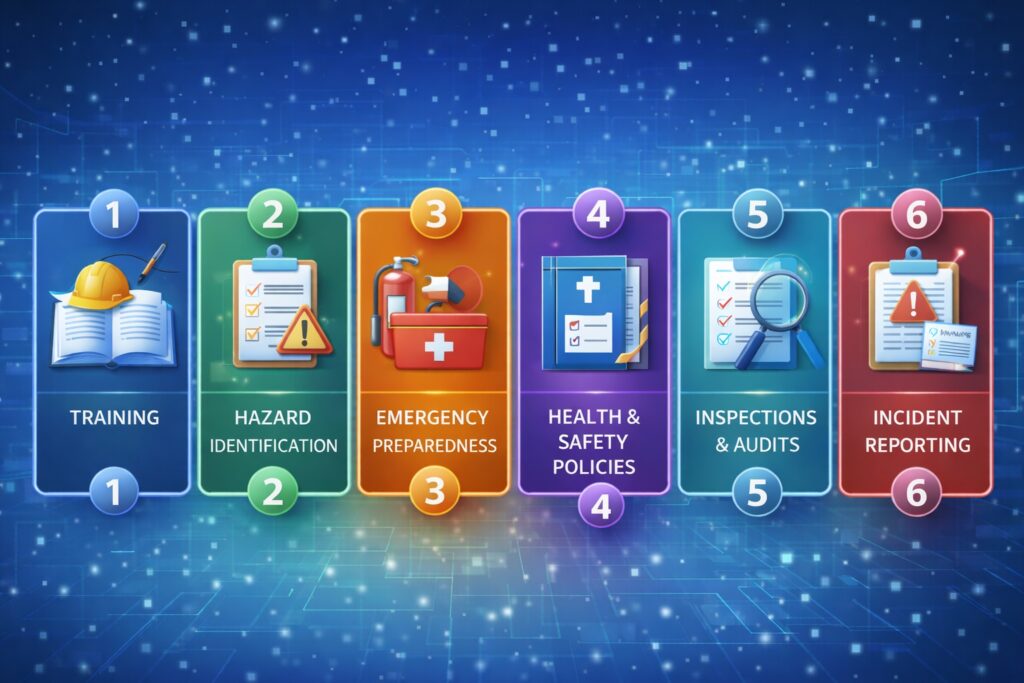

A compliant workplace safety program is the backbone of risk management for Ontario’s industrial establishments. Under the Occupational Health and Safety Act (OHSA), employers are required to take every reasonable precaution to protect workers. Meeting this obligation requires more than general awareness—it demands structure, documentation, and technical oversight aligned with Ontario workplace health and safety requirements.
A strong program integrates policy, engineering controls, inspections, and accountability. When these elements work together, organizations strengthen Ontario workplace health and safety performance while reducing exposure to enforcement action.
The Foundation of Workplace Safety in Ontario
Ontario’s safety framework is built around prevention. Rather than reacting to incidents, OHSA emphasizes identifying hazards early and controlling them through engineered solutions, procedures, and monitoring. A compliant safety program provides the structure needed to manage these responsibilities consistently.
Programs that lack clear roles or technical review often struggle to meet Ontario Occupational Health and Safety expectations, especially in environments involving machinery, electrical systems, or process hazards.
Written Policies and Internal Responsibility System
Every compliant program begins with documented policies that define responsibilities and authority. Ontario’s Internal Responsibility System assigns shared accountability to employers, supervisors, and workers.
Policies must clearly outline safety objectives, reporting expectations, and corrective action processes. Without written direction, enforcement of safety practices becomes inconsistent, weakening overall health and occupational safety performance.
Hazard Identification and Risk Control
Identifying hazards is a continuous process, not a one-time exercise. Facilities must regularly assess risks associated with equipment, layouts, and operational changes.
Effective risk control prioritizes engineered safeguards over administrative measures. This includes guarding, interlocks, safe access design, and physical barriers that prevent exposure. Programs that rely only on procedures or signage often fail to address underlying hazards tied to equipment design.
Engineering Reviews and Pre-Start Health and Safety Requirements
Engineering oversight is a critical element of compliant safety programs in Ontario. When new or modified equipment is introduced, hazards must be evaluated before startup.
Pre-start health and safety reviews required under Ontario Regulation 851 ensure that machinery, guarding, and control systems meet regulatory expectations. Integrating these reviews into the broader safety program helps prevent gaps in which equipment operates without verified safeguards.
Engineering reviews also support long-term compliance by documenting design decisions and corrective actions related to Ontario workplace health and safety obligations.
Inspection and Maintenance Programs
Routine inspections confirm that safeguards remain effective over time. Inspection programs should cover machinery, electrical systems, emergency controls, and protective devices.
Maintenance plays an equally important role. Safety-related components, such as guards, interlocks, and emergency stops, must be maintained in accordance with documented schedules. Programs that lack inspection and maintenance tracking often fall short during audits or inspections.
Emergency Procedures and Reporting
Emergency procedures ensure that workers know how to respond in the event of an incident. These procedures must be site-specific and aligned with actual hazards present in the facility.
Reporting mechanisms are equally important. Incidents, near misses, and unsafe conditions must be documented and reviewed to enable corrective actions. Transparent reporting supports continuous improvement and reinforces accountability across all levels of the organization.
Documentation and Audit Readiness
Documentation ties every element of a safety program together. Policies, inspection records, engineering reviews, and corrective actions must be retained and kept current.
Audit readiness depends on documentation accuracy. During inspections, regulators assess whether records demonstrate ongoing compliance with Ontario workplace health and safety requirements. Incomplete or outdated records often result in enforcement action, even when physical safeguards are in place.
Integrating OHSA Compliance with Practical Oversight
A compliant safety program is not built from isolated procedures. It is the result of integrated planning, engineering oversight, inspections, and documentation aligned with Ontario Occupational Health and Safety requirements.
SAFE Engineering Inc. supports industrial establishments through structured workplace health and safety programs that combine regulatory knowledge with practical engineering insight. By aligning policies with real-world hazards, organizations can strengthen health and occupational safety performance while maintaining compliance across all stages of operations. For more details, contact us!