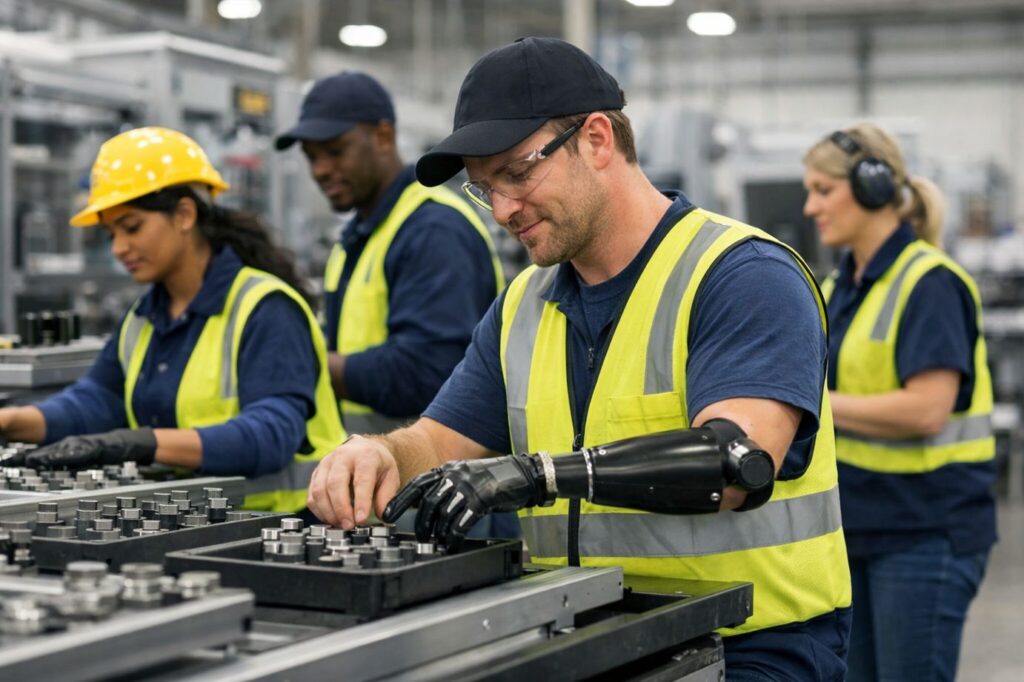

Finding steady employment can be challenging for people living with disabilities—especially in sectors that rely on rigid schedules or limited role flexibility. Ontario’s manufacturing sector is changing that narrative.
With a wide range of adaptable roles and growing awareness around inclusive hiring, manufacturing is becoming a practical pathway for job seekers seeking stability and long‑term growth. You can explore current opportunities directly through jobs for disabled people listed on our platform.
Addressing Employment Barriers for People With Disabilities
Employment barriers for people with disabilities remain well-documented. A 2024 report from the Institute for Work & Health (IWH) highlights that individuals with disabilities continue to face lower employment rates, often due to workplace inflexibility, inaccessible environments, or lack of employer awareness—not lack of ability.
Manufacturing is uniquely positioned to address some of these barriers. Unlike roles that depend heavily on customer-facing work or unpredictable schedules, industrial environments can be structured, task-focused, and adaptable. That’s why job opportunities for disabled people are increasingly found in logistics, light assembly, and operational support roles.
Entry Points in Logistics, Light Assembly, and Support Roles
Many manufacturing roles do not require heavy physical labour or advanced technical training. Entry points commonly suited to a wide range of abilities include:
- Packaging and labeling
- Quality inspection
- Inventory tracking
- Shipping and receiving coordination
- Production line support
These roles allow for task customization, seated work options, modified schedules, and assistive tools. For job seekers exploring disabled job opportunities, this variety matters. It creates space for individuals to contribute meaningfully without being excluded by one‑size‑fits‑all job designs.
Manufacturers across Ontario are increasingly recognizing that inclusive role design improves retention and workforce reliability—especially in environments facing labour shortages.
Inclusive Hiring Practices and Available Government Programs
Inclusive hiring in manufacturing often works best when paired with existing support programs. Ontario employers can access wage subsidies, job‑matching assistance, and workplace accommodation funding through federal and provincial initiatives referenced in the IWH report.
These programs support:
- Adaptive equipment or modified workstations
- Gradual return‑to‑work schedules
- On‑the‑job coaching or job carving
For job seekers, this means disabled people have access to job opportunities beyond short‑term placements. They can lead to stable employment when employers understand how to use available supports responsibly.
Importantly, effective inclusion in manufacturing is not framed as charity—it is framed as workforce participation. Employers still expect reliability, teamwork, and accountability, while offering reasonable accommodations that allow people to succeed.
How to Connect Disabled Job Seekers With the Right Opportunities
Job portals focus on making industrial hiring more transparent and more accessible. They list jobs for disabled people across Ontario that are suitable for a range of abilities, shift preferences, and experience levels—without assuming what a candidate can or cannot do.
Job portals organize postings, so job seekers can identify:
- Entry‑level industrial roles
- Employers open to accommodation conversations
- Positions that prioritize consistency and clear expectations
By reducing guesswork and highlighting realistic options, job portals help job seekers explore disabled job opportunities that align with their skills and circumstances—while allowing employers to reach motivated candidates they may otherwise overlook.
From Overlooked to Employed Through Industrial Hiring
Manufacturing will not solve every employment challenge—but it offers something many sectors do not: structure, adaptability, and room to grow. For disabled job seekers who want consistent income, clear responsibilities, and the chance to contribute, industrial roles can be a strong starting point. Ontario’s manufacturing sector continues to evolve, and inclusive hiring is becoming part of that evolution.