
Natural sunlight has powered plant growth for millions of years. However, growers in controlled environment agriculture now have access to technology that replicates these essential light wavelengths with remarkable precision. Modern indoor plant lighting systems deliver the exact spectrum plants need while offering unprecedented control over growing conditions.
What Makes Sunlight Essential for Plant Growth?
Sunlight contains a complete spectrum of wavelengths that drive photosynthesis. Plants absorb primarily blue and red light wavelengths to convert light energy into chemical energy. Blue wavelengths (400-500nm) promote compact, vegetative growth and strong leaf development. Red wavelengths (600-700nm) support flowering, fruiting, and overall biomass production.
Natural sunlight also includes green, yellow, and far-red wavelengths. While plants reflect much of the green light, these wavelengths still contribute to deeper canopy penetration. The challenge for greenhouse operations is that natural light varies by season, weather, and geographic location. This inconsistency makes year-round production difficult without supplemental lighting.
How Do Indoor Grow Lights Replicate Natural Sunlight?
Advanced indoor grow light systems use specific LEDs to emit targeted wavelengths. Each diode produces a precise color spectrum that matches the photosynthetically active radiation (PAR) plants utilize most efficiently. Unlike traditional lighting that wastes energy on wavelengths plants cannot use, LED technology focuses exclusively on beneficial spectrums.
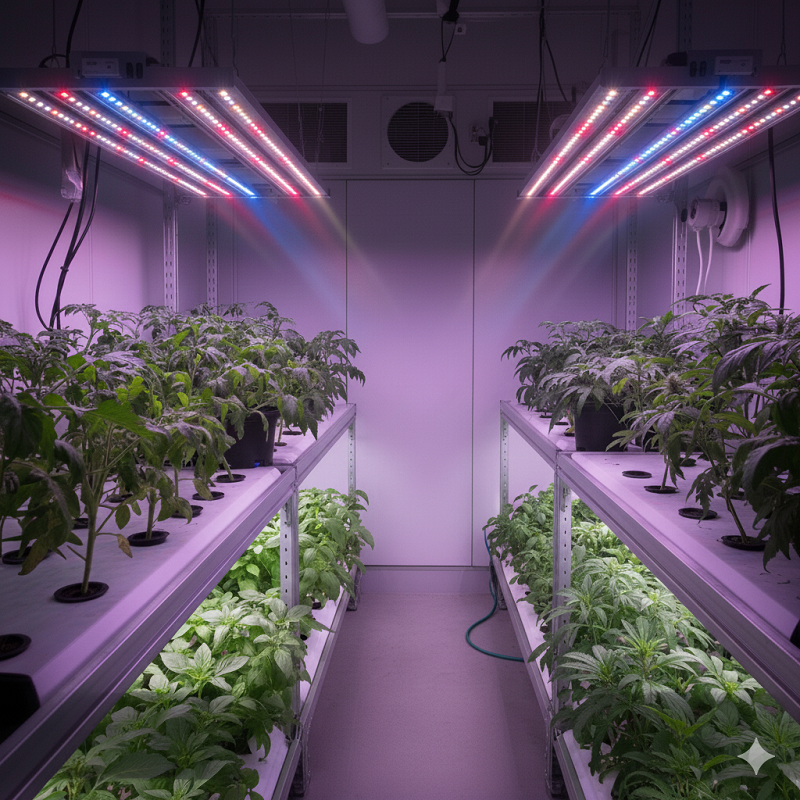
The key lies in combining multiple LED types within a single fixture. High-quality systems blend blue, red, white, and sometimes far-red diodes. This combination creates a full-spectrum output that closely mimics natural daylight. Growers can adjust the ratio of these wavelengths based on crop type and growth stage.
Modern indoor grow LED lights also maintain consistent intensity throughout the photoperiod. While outdoor sunlight fluctuates from dawn to dusk, controlled environment agriculture benefits from stable light delivery. This consistency eliminates stress from varying conditions and promotes predictable growth patterns.
Why Does Spectral Control Matter for Different Crops?
Different plant species have evolved under varying light conditions. Leafy greens thrive with higher blue light ratios that encourage compact growth. Flowering crops require increased red wavelengths to trigger reproductive stages. Fruit-bearing plants benefit from balanced spectrums throughout their extended growth cycles.
An indoor grow light system with adjustable spectral ratios allows growers to customize lighting for specific crops. This flexibility eliminates the one-size-fits-all approach of traditional lighting. Growers can program different light recipes for propagation, vegetative growth, and flowering stages within the same facility.
Temperature-sensitive crops particularly benefit from LED technology. These systems emit significantly less radiant heat than high-pressure sodium (HPS) fixtures. Lower heat output reduces HVAC cooling requirements, cutting operational costs while maintaining optimal growing temperatures. Plants can grow closer to the light source without risk of heat stress or tissue damage.
Can LED Technology Match Natural Sunlight Intensity?
Photosynthetic photon flux density (PPFD) measures the amount of usable light reaching plant surfaces. Professional greenhouse operations require high PPFD levels to maximize photosynthetic rates. Quality LED fixtures now deliver PPFD values comparable to or exceeding full sunlight in many applications.
Key performance metrics include:
- Photosynthetic Photon Efficacy (PPE) ratings above 2.4 μmol/J
- Consistent light distribution across the canopy
- Minimal light degradation over 50,000+ operational hours
- Precise spectral output matching plant absorption peaks
The efficiency advantage of LED technology becomes clear in energy consumption. Modern systems convert electrical input to usable plant light at rates 60-70% higher than conventional fixtures. This efficiency translates to lower operating costs and reduced environmental impact for commercial operations.
What Role Does Light Duration Play in Plant Development?
Beyond spectrum and intensity, photoperiod duration significantly affects plant physiology. Most crops require 14-18 hours of light daily for optimal vegetative growth. Flowering plants often need specific light-dark cycles to trigger reproductive stages. Precision timing ensures crops develop according to production schedules.
Indoor plant lighting systems with programmable controls automate photoperiod management. Growers can set sunrise and sunset times that align with crop requirements. This automation eliminates manual intervention and ensures consistency across multiple growing cycles. Advanced systems also support gradual intensity ramping that mimics natural dawn and dusk transitions.
How Does Color Temperature Affect Plant Response?
Color temperature describes the visual appearance of light. Cool white light (5000-6500K) contains more blue wavelengths and appears similar to midday sunlight. Warm white light (2700-3000K) has increased red content and resembles evening light. While color temperature primarily affects human perception, it correlates with spectral distribution that influences plant growth.
Full-spectrum indoor grow lights balance color temperature to support all growth stages. A neutral white appearance (4000K) typically indicates good spectral distribution for general horticulture. However, the actual wavelength composition matters more than visual appearance. Quality fixtures provide detailed spectral power distribution charts showing exact nanometer outputs.
What Advantages Do LED Systems Offer Over Traditional Lighting?
Traditional HPS fixtures have served greenhouse operations for decades. However, LED technology delivers multiple advantages that improve both crop performance and operational efficiency. The lower heat signature reduces cooling costs substantially in climate-controlled facilities. Fixtures can mount closer to crops, maximizing light capture while conserving vertical space.
Longevity represents another significant benefit. Quality LED systems operate for 50,000 hours or more with minimal light degradation. This extended lifespan reduces replacement frequency and maintenance labor. Instant on-off capability eliminates warm-up periods required by HPS systems, providing immediate full-spectrum output.
The directional nature of LED light also improves efficiency. Unlike omnidirectional bulbs that require reflectors, LEDs emit light in focused patterns. This characteristic reduces wasted light and concentrates photons on the crop canopy. Growers achieve higher effective PPFD with lower total wattage consumption.
Partner With us for Professional Greenhouse Lighting Solutions
We specialize in advanced LED grow lighting systems engineered for professional greenhouse and vertical farming operations across North America. Our fixtures feature innovative digital color ratio technology that allows precise spectral adjustments throughout crop cycles. With proven performance for demanding clients including the Canadian military and governmental bodies, we deliver reliable solutions that optimize photosynthetic efficiency and maximize crop yield. Contact us today to discover how our professional-grade indoor grow light systems can transform your controlled environment agriculture operation.