
Manufacturers and fabricators across Ontario rely on protective coatings to preserve metal integrity, control corrosion, and maintain long-term performance. While this blog focuses on Toronto’s manufacturing environment, many organizations compare providers across regions, including powder coating services in Ottawa, when evaluating quality benchmarks. Regardless of location, consistent quality standards separate reliable coating operations from those that introduce risk.
Powder coating quality is defined by process control, inspection discipline, and repeatability. Understanding the standards that underpin reliable coating performance helps decision-makers select a provider capable of delivering durable, compliant results.
Understanding Quality Standards in Powder Coating
Quality standards in powder coating extend beyond visual appearance. They encompass surface preparation, application consistency, curing accuracy, and inspection procedures. Each step influences coating adhesion, corrosion resistance, and service life. When these standards are not followed, coatings may fail prematurely despite meeting basic thickness or appearance requirements.
1. Proper Surface Preparation and Pretreatment Standards
Surface preparation is the foundation of coating performance. Oils, mill scale, corrosion, and contaminants must be removed before coating application. Pretreatment processes such as cleaning and conversion coatings improve adhesion and corrosion resistance.
A reliable powder coating service applies standardized surface preparation procedures to ensure coatings bond correctly and perform consistently.
2. Consistent Coating Thickness Control
Uniform coating thickness is critical for predictable performance. Thin areas reduce corrosion protection, while excessive build-up may lead to cracking or improper curing. Consistency across edges, welds, and complex geometries reflects strong process control.
Quality-focused powder coating operations measure and verify thickness at every stage of production rather than relying solely on averages.
3. Adhesion and Cure Validation Procedures
Proper curing ensures coatings achieve their designed mechanical and chemical properties. Under-curing weakens durability, while over-curing can reduce flexibility and impact resistance.
Adhesion testing and cure validation confirm that coatings have bonded correctly and reached full performance potential.
4. Corrosion Resistance and Environmental Performance
Powder coatings must withstand moisture, temperature variation, and environmental exposure without degrading. Corrosion resistance testing verifies that coatings provide long-term protection under service conditions.
Quality providers align coating selection and application with environmental performance requirements.
5. Controlled Application and Equipment Calibration
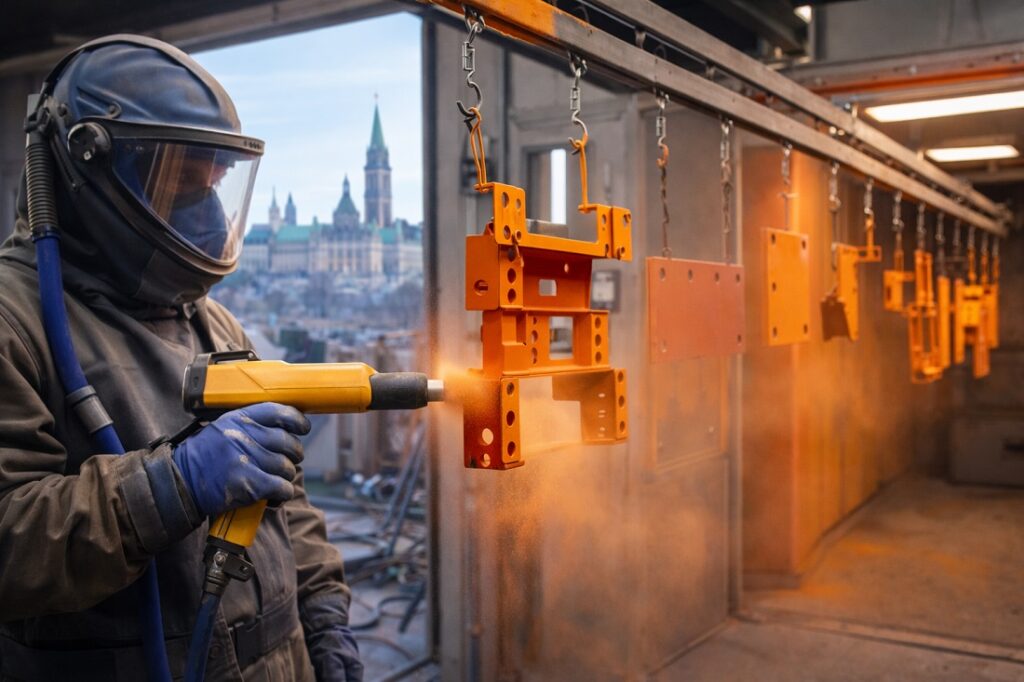
Application equipment must be properly calibrated to maintain consistent powder flow, electrostatic charge, and spray patterns. Variations in equipment settings often lead to uneven finishes and thickness variations.
Controlled application processes support repeatable, high-quality outcomes across production runs.
6. Quality Inspection and Documentation Practices
Inspection practices verify that coatings meet specified requirements before parts move downstream. Visual checks, thickness measurements, and adhesion testing provide measurable confirmation of quality.
Documentation supports traceability and accountability, particularly for industrial and commercial projects with compliance requirements.
7. Compliance with Industry and Customer Specifications
Many projects require adherence to specific coating standards or customer-defined specifications. Failure to meet these requirements can result in rejected parts or project delays.
A professional powder coating provider ensures that coatings meet documented specifications and quality expectations.
8. Rework Prevention and Process Repeatability
Rework often indicates inconsistent processes. Quality-focused operations prioritize repeatability to minimize defects and reduce waste.
Stable, controlled processes deliver consistent results while lowering long-term costs.
How to Evaluate Powder Coating Quality Before Choosing a Service Provider
Evaluating powder coating quality requires more than reviewing finished samples. Indicators of reliability include documented procedures, inspection protocols, process control measures, and experience with similar components.
Comparing providers across regions, including powder coating service operations in Toronto, helps identify those committed to quality rather than short-term cost savings.
Why Manufacturers in Toronto Should Prioritize Quality Over Lowest Cost
Low-cost coating solutions often sacrifice process control, inspection, or material selection. These shortcuts increase the risk of premature failure, rework, and asset downtime.
Investing in quality powder coating reduces lifecycle costs and protects operational reliability.
Choosing a Powder Coating Service in Toronto That Meets Real Quality Standards
Powder coating quality is defined by disciplined processes, inspection rigor, and repeatable results. Surface preparation, thickness control, curing accuracy, and compliance all contribute to long-term coating performance.
Professional Powder Coating delivers controlled, quality-driven coating solutions designed to meet demanding industrial and commercial requirements. With proven capabilities supporting projects across Ontario, including powder coating service in Mississauga, the focus remains on consistency, durability, and measurable quality.
Connect with the team today to discuss powder coating solutions built on real quality standards.