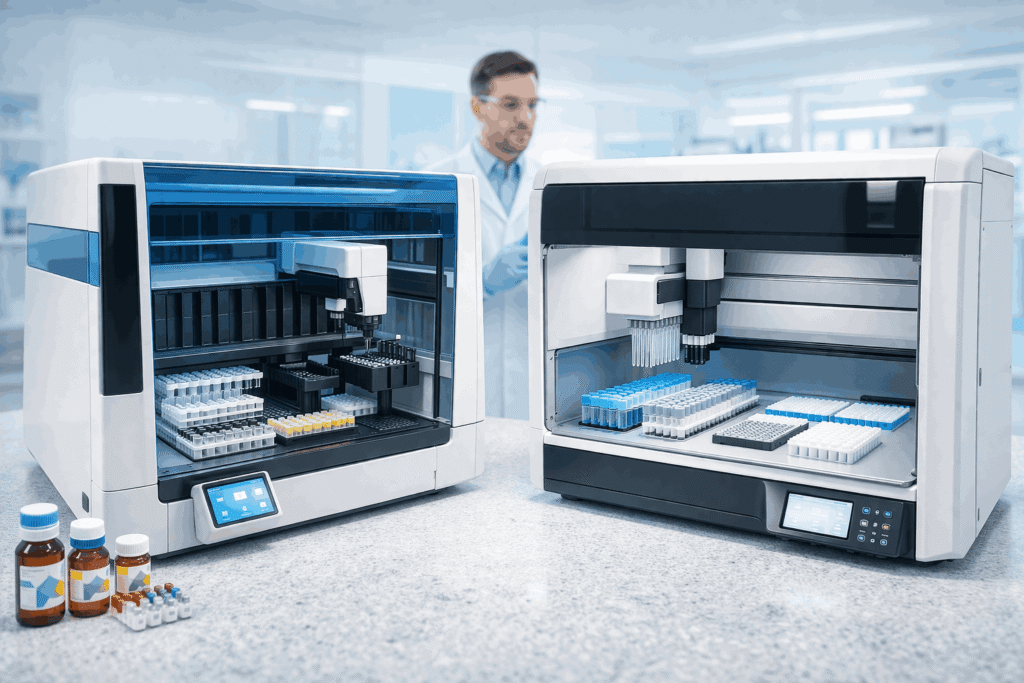

Liquid handling automation has become a defining component of modern biotech laboratories. As assay complexity increases and throughput demands grow, manual pipetting can no longer keep pace with operational requirements.
Labs evaluating automation often face a key decision: whether to invest in a standalone automated liquid handler or adopt a more comprehensive automated liquid handling system. Understanding the differences between these options is essential for selecting a solution aligned with your lab’s workflow, scale, and long-term strategy.
Overview of Liquid Handling Automation
Liquid-handling automation replaces manual pipetting with programmable, repeatable robotic pipetting. These systems aspirate, dispense, mix, and transfer liquids with precise volume control and timing consistency.
Automation reduces variability from manual techniques and fatigue while increasing throughput across assays. It is widely used in drug discovery, genomics, ELISA workflows, compound management, and high-throughput screening.
However, not all liquid handling automation is structured the same way. The distinction between an individual automated liquid handler and a fully integrated liquid handling system often determines scalability and workflow flexibility.
Functioning of the Automated Liquid Handler
An automated liquid handler is typically a programmable robotic platform designed to perform liquid-transfer tasks. It performs aspirating, dispensing, dilution, and mixing steps based on defined protocols.
Standalone handlers are often ideal for:
- Repetitive assay preparation
- Plate replication and reformatting
- Controlled reagent addition
- Mid-scale throughput environments
These systems improve accuracy and consistency while reducing manual intervention. For labs transitioning from manual workflows, a single automated liquid handler may provide immediate gains in efficiency and reproducibility.
However, standalone platforms may operate independently unless integrated with additional robotics or scheduling systems.
What Defines a Full Liquid Handling System
In contrast, automated liquid handling systems represent integrated automation ecosystems. These systems combine liquid handlers with robotic plate movers, incubators, storage systems, readers, and orchestration software.
A full system typically includes:
- Robotic transport between devices
- Scheduling coordination
- Integration with data management platforms
- Automated workflow sequencing
Rather than performing a single step, integrated systems manage entire experimental processes from preparation through analysis.
At Retisoft, we often work with labs that start with a standalone handler and later expand to integrated systems as throughput and coordination requirements increase. The right path depends on workflow complexity and growth expectations.
Side-by-Side Comparison: Cost, Scale, Flexibility
When comparing an automated liquid handler to broader automated liquid handling systems, several factors stand out.
Cost
Standalone handlers generally require lower upfront investment and infrastructure. Full systems involve higher capital costs due to robotics, integration, and orchestration layers.
Scale
Single handlers support moderate throughput efficiently. Integrated systems are designed for high-throughput labs running multiple concurrent workflows.
Flexibility
Standalone units are flexible for defined tasks but may require manual coordination between steps. Integrated systems offer dynamic workflow management but may require more structured planning during implementation.
Labs with focused, repetitive assays may benefit from starting with a standalone handler. High-throughput labs that operate complex, multi-step workflows often achieve greater long-term efficiency with integrated automation.
Software Considerations When Choosing Between the Two
Hardware capabilities are only part of the decision. Software coordination determines how effectively liquid handling integrates into broader workflows.
Standalone handlers rely on onboard protocol software. While powerful, this may limit coordination with other instruments unless additional integration layers are implemented.
Fully automated liquid handling systems rely on orchestration software that schedules tasks, manages dependencies, and adapts to real-time conditions.
At Retisoft, we emphasize that software is the connective layer that transforms liquid handling from a single automated task into a coordinated workflow component. Scheduling and integration platforms ensure liquid handling aligns with robotic transfers, incubation timing, and data capture without manual oversight.
Labs evaluating options should consider not just what the liquid handler can do, but how it fits within the broader automation strategy.
Conclusion
Choosing between an automated liquid handler and comprehensive automated liquid handling systems depends on your lab’s current scale, workflow complexity, and long-term growth plans.
Standalone platforms offer accessible automation with measurable efficiency gains. Integrated systems deliver higher coordination and scalability for labs operating at advanced throughput levels.
At Retisoft, we help biotech teams evaluate liquid handling strategies based on real workflow requirements rather than feature checklists. By aligning hardware with orchestration software and integration planning, labs can select solutions that support both present needs and future expansion. To explore how to choose the right platform for your lab, contact us now!