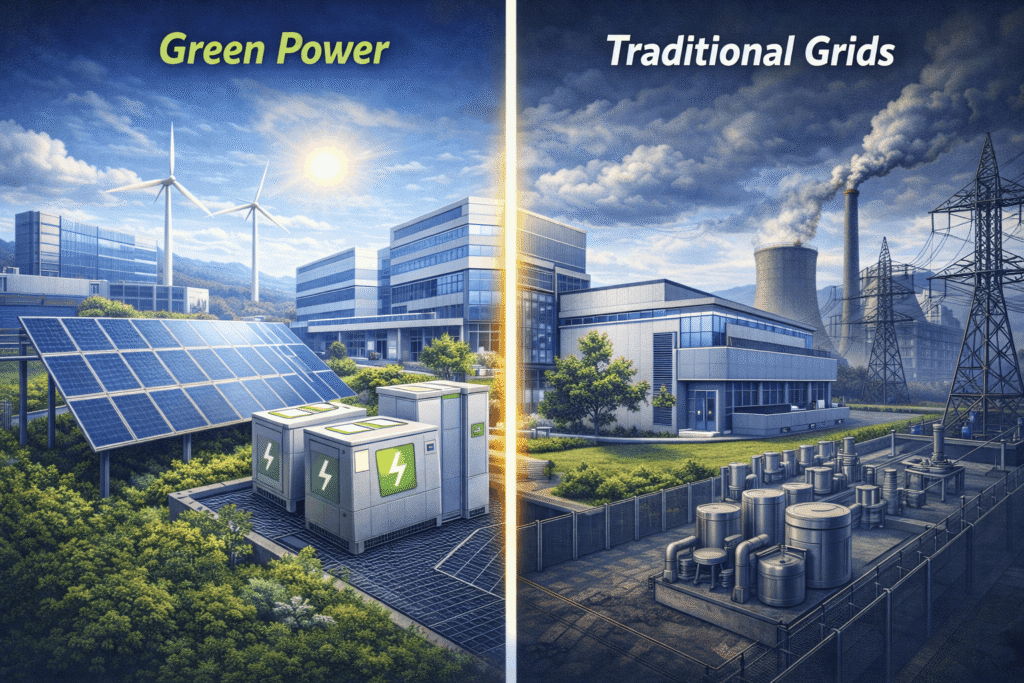

Data centers depend on electricity more than any other physical input. Power reliability, cost stability, and long term availability directly determine uptime, performance, and operating margins. As energy demand increases, operators increasingly compare green power versus traditional grid models to decide which approach best supports modern digital infrastructure.
This comparison has become more urgent as AI workloads, high density compute, and distributed architectures raise baseline power requirements. Selecting the right energy source now influences both technical resilience and long term financial performance.
What Defines Traditional Grid Power For Data Centers?
Traditional grid power relies on centralized generation sources, including coal, natural gas, nuclear, and large-scale hydro. Power flows through regional transmission networks before reaching data center facilities.
This model supported early data center growth, but structural constraints have become more pronounced. Grid congestion, interconnection delays, rising demand charges, and aging transmission infrastructure increasingly affect power availability and cost predictability across many regions.
For operators, grid reliance introduces exposure to price volatility, regional outages, and infrastructure bottlenecks. As compute demand grows, these limitations create operational risk for facilities tied solely to centralized grids.
How Does Green Power Change Data Center Energy Planning?
Green power for data centers shifts energy generation closer to the facility. Rather than relying exclusively on centralized grids, operators integrate on site or nearby renewable generation directly with compute infrastructure.
Renewable energy systems typically combine solar generation with battery storage, with optional natural gas backup in some deployments. This configuration supports continuous operation while reducing exposure to grid instability and transmission constraints.
Sustainable data center power models prioritize predictable output, long-duration stability, and controlled energy costs. By generating power at or near the data center, operators gain greater control over availability and performance during peak demand periods.
How Do Reliability And Uptime Compare Between These Models?
Reliability drives every data center decision. Traditional grid power depends on upstream transmission health and regional load balance. During extreme weather or demand spikes, grid stress can lead to curtailments or outages.
Green power architectures reduce dependency on distant infrastructure. On-site generation paired with battery storage maintains uptime during grid disruptions. This model supports extended training cycles and high-utilization workloads that cannot tolerate interruptions.
From an operational perspective, green power versus traditional grid reliability often favors decentralized energy systems designed specifically for continuous, high utilization compute workloads.
What Are The Cost Differences Between Green Power And Traditional Grids?
Cost structures differ significantly between these approaches. Traditional grids expose operators to demand charges, peak pricing, and long-term rate escalation. These variables complicate budgeting for compute-intensive workloads.
Green power models stabilize energy costs by fixing a portion of generation economics on site. Solar and battery systems reduce exposure to peak pricing, congestion fees, and demand driven rate adjustments, improving long term budgeting accuracy.
Key cost factors often include:
- Energy costs remain more stable across multi year operating periods.
- On site generation reduces exposure to demand charges during peak load events.
- Operators face lower risk of sudden pricing spikes tied to regional grid stress.
How Do Green Power And Traditional Grids Compare Across Key Metrics?
Differences between green power and traditional grid energy become clearer when evaluated across core operational and financial metrics.
| Comparison Area | Green Power For Data Centers | Traditional Grid Power |
| Primary Energy Source | Solar paired with battery storage and optional gas backup | Centralized grid using mixed fossil, nuclear, and hydro |
| Reliability Model | Localized generation reduces dependence on transmission networks | Dependent on regional grid stability |
| Cost Predictability | Stable and controlled over long operating periods | Variable pricing and demand charges |
| Deployment Timelines | Faster activation using modular infrastructure | Slower due to interconnection delays |
| Scalability | Modular and distributed expansion | Limited by grid capacity |
| Support For AI Workloads | Designed for long-duration, high-density compute | Often constrained during peak demand |
How Do Sustainability Goals Influence Data Center Power Choices?
Sustainability is no longer optional for enterprise infrastructure. Many organizations must meet emissions targets, reporting requirements, and investor expectations.
Renewable energy for data centers directly supports these goals by lowering carbon intensity. Facilities powered by solar and battery systems align with environmental, social, and governance priorities without sacrificing performance.
Sustainable data center power also supports evolving regulatory and reporting requirements. Operators adopting renewable backed energy models reduce long term transition risk while strengthening credibility with customers, regulators, and capital providers.
Which Data Center Energy Sources Support Faster Deployment?
Deployment speed is a growing constraint. Traditional grid-connected facilities often wait years for interconnection approvals and infrastructure upgrades.
Green power deployments avoid many interconnection delays by pairing modular data center infrastructure with on site energy systems. Facilities reach operation in months rather than years, supporting faster market entry and earlier revenue generation.
Decentralized energy systems allow operators to deploy capacity where power already exists or can be generated locally. This flexibility directly supports distributed computing strategies and edge deployments.
How Does Green Power Support Modern Distributed Data Centers?
Distributed architectures require localized power reliability. Centralized grid systems were not designed to support high density compute clusters operating across multiple independent locations.
Green power models align naturally with distributed infrastructure. Each site operates with its own energy system, reducing single points of failure. Battery storage smooths fluctuations and supports continuous workloads.
This structure fits AI training, inference, and edge computing use cases that require consistent performance across locations.
Powering The Next Generation Of Data Centers
Energy strategy increasingly defines modern data center design. Renewable backed power models deliver the reliability, predictability, and flexibility required by advanced workloads as organizations evaluate green power versus traditional grid options.
Flux Core Data Systems delivers modular, solar and battery powered distributed data centers that activate in as little as 90 days. These systems operate on resilient, sustainable energy designed to support the next generation of high density and distributed compute workloads.