
How much does a failed 3D print truly cost? Beyond wasted filament, failed builds consume machine time, delay projects, and disrupt production schedules. That is where 3D printer monitoring becomes critical.
A single unnoticed failure can stop an entire workflow. Print farms, classrooms, and enterprise labs cannot rely on chance. Structured monitoring systems reduce uncertainty and protect operational efficiency.
Understanding Common 3D Print Failures
Layer shifting, nozzle clogs, bed adhesion issues, and filament tangles rank among the most common failures. These problems often start early but remain unnoticed until hours later.
When no 3D print monitor is active, prints continue running despite visible defects. By the time operators check the build, material waste, and lost time have already accumulated.
What Is 3D Printer Monitoring?
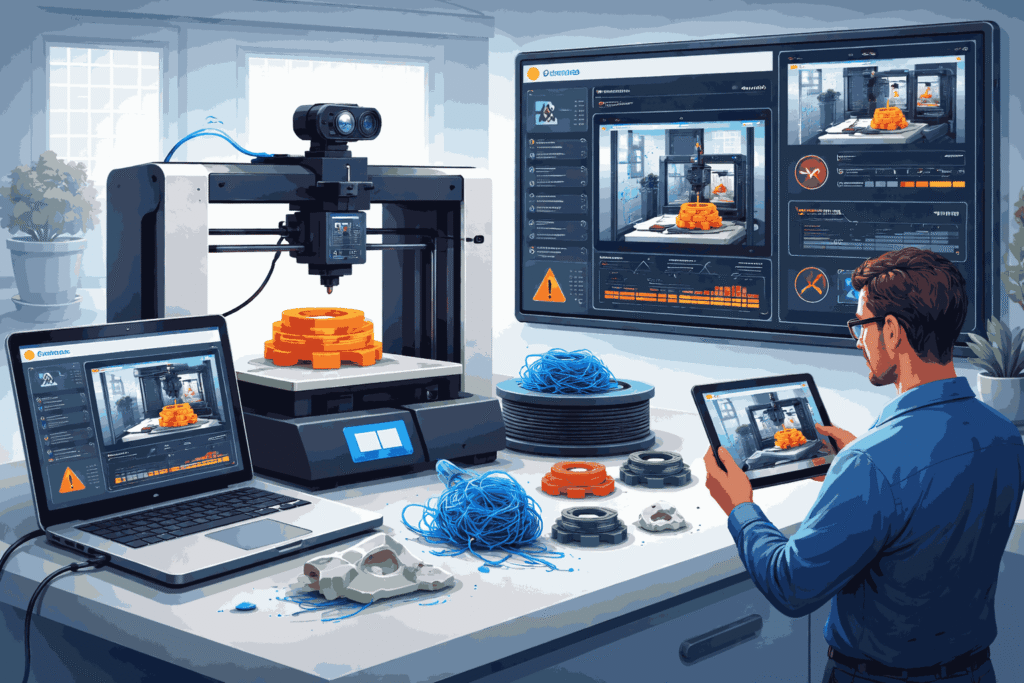
3D printer monitoring refers to systems that track print activity through cameras, sensors, and software dashboards. A 3D print monitor provides visual confirmation of print progress, while advanced platforms track performance data and job status.
Monitoring creates transparency. It allows operators to detect issues early rather than waiting for a complete failure.
Reactive Monitoring vs Proactive Monitoring Systems
Reactive systems rely on manual observation. An operator monitors a camera feed and intervenes if anything appears abnormal.
Proactive systems integrate automated alerts and performance tracking. They identify irregularities and notify users before problems escalate. Proactive 3D printer monitoring reduces dependency on constant manual oversight.
Webcam-Only Monitoring vs Intelligent Print Monitoring Software
A simple webcam serves as a visual 3D-print monitor. While helpful, it lacks analysis capability. Human supervision remains necessary.
Intelligent platforms analyze data patterns, job status, and device behavior. Advanced print monitoring software integrates slicing control, remote management, and user permissions. This approach transforms monitoring from passive viewing into active workflow control.
Real-Time Alerts vs Post-Print Error Discovery
Without alerts, failures surface only after completion. That delay wastes hours of machine time.
Systems with real-time notifications stop prints quickly. Email or dashboard alerts allow rapid intervention. Fast response prevents extended filament waste and reduces downtime.
Single-Printer Monitoring vs Fleet-Wide Monitoring Platforms
Monitoring one printer differs from managing dozens. Single-device setups may rely on a basic 3D print monitor.
Fleet-wide platforms provide centralized dashboards, queue management, and usage tracking. Structured 3D printer monitoring ensures consistent oversight across multiple machines and locations.
Downtime and Material Waste: With vs Without Monitoring
Without monitoring, failures extend until someone notices. This scenario increases material waste and delays production.
With centralized monitoring, teams detect issues early and reallocate jobs efficiently. Reduced downtime improves overall throughput and operational predictability.
Security and Remote Access Considerations
Remote access increases flexibility but requires safeguards. Open camera feeds and unsecured systems expose intellectual property risks.
Secure monitoring platforms incorporate user authentication, encrypted access, and role-based permissions. These controls protect sensitive files and maintain compliance standards.
Which Monitoring Approach Is Right for You?
Small setups may rely on basic webcam oversight. Growing labs and enterprises require structured dashboards, analytics, and centralized control.
Selecting the appropriate 3D printer monitoring solution depends on printer volume, workflow complexity, and collaboration needs. Scalable systems adapt as production demands increase.
Prevention Is Cheaper Than Reprinting
Failed prints cost time, materials, and credibility. Structured oversight prevents small issues from becoming large setbacks.
Platforms such as 3DPrinterOS combine remote management, centralized dashboards, and automated alerts to improve operational reliability. Preventive systems reduce waste and improve consistency across distributed environments.
Investing in intelligent print monitoring software ensures stronger control, better visibility, and fewer costly failures.
Improve reliability and reduce downtime with 3DPrinterOS today.