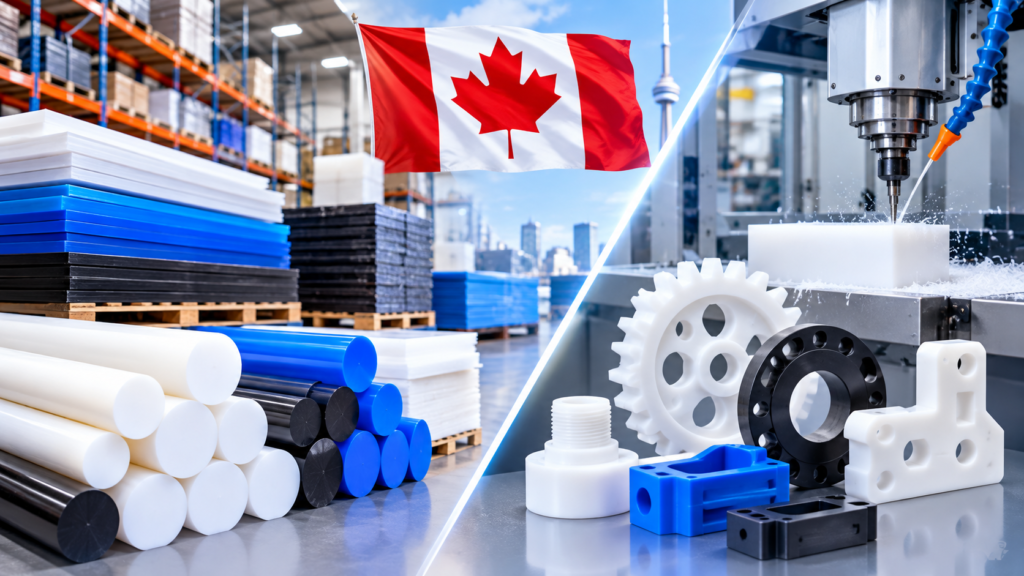

Buyers often search for a plastic manufacturer when the real need is different. Some need standard sheets, rods, or tubes. Others need finished parts built to a drawing. These needs call for different partners. This guide compares a stock supplier with a custom fabrication partner. It also clarifies what buyers should expect from a plastic manufacturer in Canada before sending an inquiry.
People Also Ask
What does a plastic fabricator do?
A plastic fabricator takes sheet, rod, and tube and cuts, CNC machines, routes, bends, thermoforms, and welds them to create a finished part. They do this to specification, and the parts are ready to fit into your project.
Is a plastic fabrication company the same as a plastic supplier?
Not necessarily. Plastic suppliers provide materials in standard sizes. A plastic fabrication company will fabricate parts to your specifications. Some companies do both so you can order materials and finished components from one place.
How long does custom plastic fabrication take?
This will depend on how complex the part is, how readily available the material is, and how busy the shop is. Simple cut parts can be delivered in a few days. Machined or welded assemblies can take a few weeks. Ask for an exact delivery date when asking for a quote.
Three Roles in the Plastics Supply Chain
Plastic sourcing involves three kinds of companies. Each plays a different part.
- Manufacturer: Produces raw sheet, rod, and tube through extrusion or casting. Sells in bulk with high minimums.
- Stock supplier: Holds inventory from several mills. Sells standard sizes in smaller quantities. Often cuts to size.
- Fabricator: Shapes material into finished parts through machining, bending, welding, and thermoforming.
A plastic manufacturer in Canada typically sells to distributors and large OEMs. A small plant needing ten sheets rarely buys direct. That is where stock suppliers fit.
A plastic fabricator adds labor and tooling on top of the material. The result is a finished part, not a raw shape.
Side-by-Side Comparison
| Factor | Stock Supplier | Custom Fabrication Partner |
| Output | Sheet, rod, tube | Finished parts |
| Drawings needed | No | Yes |
| Order size | Small to medium | Prototype to production runs |
| Lead time | Days | Days to weeks |
| Cost driver | Material and cutting | Material, setup, and machine time |
| Best for | Repairs, standard sizes | Built-to-print parts |
When a Stock Supplier Fits
Stock material works well in these cases:
- Standard sizes meet the need
- Repair jobs need fast turnaround
- Prototypes need small quantities
- In-house staff can cut and drill parts
Stock suppliers carry a wide range, including acrylic, polycarbonate, polypropylene, PEEK, PTFE, and nylon. Buyers can compare grades in one place.
When a Custom Fabrication Partner Fits
Custom work makes sense when:
- Parts need tight tolerances
- Designs include holes, pockets, bends, or welded seams
- Orders repeat on a schedule
- In-house labor costs more than outsourcing
A plastic fabrication company also catches design problems early. Wall thickness, corner radii, and material choice all affect cost. A capable shop flags these issues before cutting starts.
Fabricators also cut scrap. They nest parts on each sheet to reduce waste.
Cost Beyond Sheet Price
The sheet price may not tell the whole story. If you need to cut a sheet to size, you may find that the cheaper sheet is actually more expensive when you factor in labor, waste, and rework. Fabricators have setup costs, but the more you order, the cheaper each part becomes.
For small one-offs, using stock material and basic cutting will be better. Ask for a quotation using both methods and see which is cheapest overall.
Quality and Documentation
Traceability is often required in food, medical, and chemical applications. This can be achieved by ensuring that materials have certification and lot numbers so that they can be audited.
Fabricators should also know how they check critical dimensions, and clear records help avoid disagreements when reordering.
The Hybrid Option
Companies that offer stock and fabrication services will avoid any handovers. Stock can be delivered directly to the shop floor with no extra delivery costs, and one team can carry out quality checks.
Lead times can be reduced at a plastic fabrication company that has stock available. Communication is made easier as there is only one point of contact for the entire order.
Questions to Ask Before Choosing
- Does the shop hold the needed material in stock?
- What tolerances can the equipment hold?
- Are CNC machining and welding done in-house?
- Which file formats does the quoting team accept?
- What is the typical lead time for repeat orders?
- Can material certifications be provided?
Picking a Plastic Fabrication Company Based on Project Needs
Buyers should match the partner to the job. Standard material points to a stock supplier. Built-to-print parts point to a plastic fabrication company. Johnston Industrial Plastics, founded in 1942, supplies sheets, rods, and tubes, along with machining, fabrication, and cut-to-size services. Warehouses in Toronto, Montreal, Winnipeg, and Edmonton serve buyers across Canada. Contact Johnston Industrial Plastics at toronto@johnstonplastics.com or 416-252-9551 to review a project.
Frequently Asked Questions
What is the difference between a plastic manufacturer and a plastic fabricator?
A manufacturer will produce raw Plastic materials such as sheet, rod, and tube. The fabricator then cuts, machines, bends, and welds these materials to create finished items. Many purchasers will require a fabricator.
Can one company supply stock and fabricate parts?
Many suppliers will have stock and can cut, machine, and fabricate. This reduces handling and delivery. You can get everything from material to finished item from one place, often reducing lead time and making quality control easier.
What does a plastic fabricator need to prepare a quote?
Most fabricators will need a drawing or CAD file. They also need to know the material, thickness, quantity, and tolerances. Knowing what finish you need and what delivery date you want will also help. The clearer the information, the faster you will get a quote and the fewer changes you’ll need.
When should a buyer choose stock over custom parts?
Stock fits standard sizes, repair work, and prototypes where speed matters. Custom fabrication fits repeat parts with set dimensions, holes, or bends. Buyers should compare total cost, including labor and scrap, not only sheet price.
Which plastics can a fabricator machine?
Fabricators work with acrylic, polycarbonate, polypropylene, PEEK, nylon, and PTFE, among others. Each material needs different tooling and speeds. Buyers should confirm the shop has experience with the chosen plastic before ordering.
