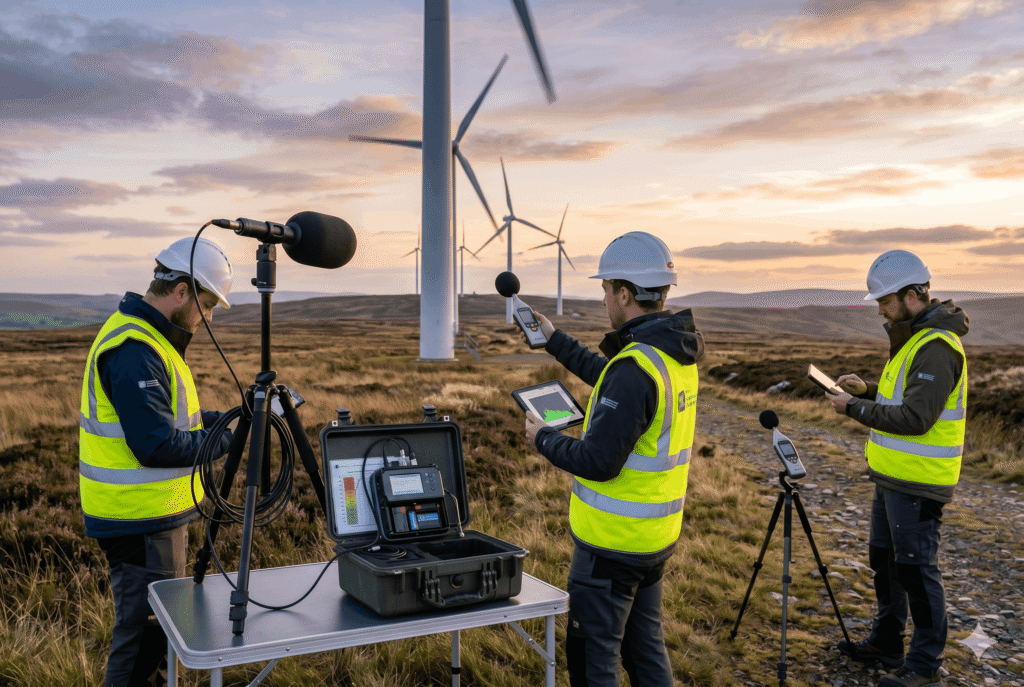

Effective wind turbine noise monitoring provides continuous acoustic tracking across changing operating, weather, and receiver-side conditions. For project owners, planners, engineers, and regulators, this creates a stronger evidence base than relying only on a short review window. The procurement question is not which method appears more rigorous, but which approach reduces approval friction, operating uncertainty, and dispute exposure for the project.
Option A is continuous acoustic monitoring. Option B is a standard wind turbine noise assessment completed during a defined measurement period. Both can support compliance, but they serve different risk profiles. For wind farms and related infrastructure, continuous monitoring provides broader operational evidence, while standard assessments may be suitable when the scope is limited, conditions are stable, and the review question is narrow.
Valcoustics Canada Ltd. fits this comparison as a consulting engineer, not a consumer service provider. The decision involves acoustic monitoring, noise and vibration analysis, compliance support, and regulator-facing documentation for infrastructure, commercial construction, wind farms, and large-scale residential development contexts.
What Project Teams Are Really Comparing
Before selecting a monitoring strategy, project teams should clarify the evidence standard required by the project. The difference is not only technical; it affects procurement, regulatory communication, and long-term risk management.
Key comparison points include:
- How much operating variability must be documented
- Whether the project requires short-term verification or long-term acoustic evidence
- How likely regulators are to request additional supporting data
- Whether stakeholder concern could trigger future review
- Whether turbine output, wind conditions, and background sound conditions vary significantly
For low-risk or early-stage review, a standard assessment may be sufficient. For higher-risk wind farm projects, continuous monitoring usually provides a more defensible compliance record.
Which Method Improves Monitoring Accuracy?
Accuracy differs most where weather, turbine output, and ambient masking shift faster than a scheduled audit can represent. Continuous monitoring captures fluctuating wind shear, source strength changes, and receiver-side immission patterns as they occur. A standard assessment generally validates conditions only during the selected attendance window.
Why Continuous Data Reduces Sampling Risk
Continuous monitoring lowers sampling risk because it records changing site conditions over time. This helps project teams understand how turbine operations behave under different operating states rather than relying on one selected measurement period.
Continuous monitoring can help capture:
- Variable wind speeds and wind shear
- Changes in turbine source strength
- Receiver-side immission patterns
- Shifting background sound conditions
- Short-duration exceedance events
- Operating conditions that may not occur during a scheduled assessment window
Reliable wind turbine noise measurement also depends on separating turbine-related acoustic output from background sources. Continuous systems can support remote processing and longer-term data review across a wider operating envelope. Standard assessments depend more on field conditions at the time of measurement and may require repeat attendance if wind, weather, or background sound conditions are not suitable.
How Does Continuous Monitoring Compare for Compliance?
Compliance value depends on how well the evidence package supports regulator expectations. Continuous monitoring typically provides a more complete immission record for operating assets. A standard assessment can still be adequate where approval questions are limited and the acoustic environment is predictable.
Compliance Advantages of Continuous Monitoring
Continuous monitoring gives compliance teams a stronger audit trail under changing operating conditions. It can identify emerging nonconforming trends earlier and support cleaner data submissions through structured analysis.
This is especially important when wind farms face:
- Ongoing regulatory scrutiny
- Variable operating conditions
- Community or stakeholder concern
- Long-term operational review requirements
- Potential disputes over acoustic output
- Requests for evidence across multiple turbine operating states
A standard wind turbine noise assessment may be easier to procure and faster to complete. However, it carries a higher miss-risk posture if critical thresholds occur outside the scheduled measurement period. If reviewers request evidence across multiple operating states, the project may face rework, repeat measurements, or delays.
When Standard Noise Assessments Still Make Sense
Standard assessments are not automatically weaker. They are appropriate when the project question is clearly defined, conditions are stable, and the required evidence can be captured within a controlled review window. They can also support early procurement filtering, preliminary planning, or limited verification where long-term operational data is not required.
Best-Fit Conditions for Standard Assessments
A standard assessment may be suitable when:
- The review question is narrow
- Operating conditions are predictable
- The project is in an early planning or screening stage
- Long-term monitoring is not required by the approval pathway
- The acoustic environment is stable enough for a representative snapshot
- The project team needs a bounded technical review before deciding on broader monitoring
The limitation is evidentiary scope. A standard assessment should not be treated as a substitute for longitudinal monitoring when operating variability, approval sensitivity, or dispute risk is high. In those settings, a continuous record is more defensible because it documents how acoustic output changes over time.
Verdict: Which Strategy Fits Your Project?
The right approach depends on scrutiny, variability, and the consequence of an incomplete evidence file. For projects facing strict approval sensitivity, variable wind regimes, or heightened stakeholder concern, continuous monitoring is usually the stronger fit. It reduces evidentiary gaps and supports defensible compliance dialogue.
Where the scope is preliminary, operating conditions are stable, and the procurement goal is bounded screening, a standard assessment may be appropriate. It limits deployment burden without claiming to provide long-term assurance.
| Scenario | Option A Is Best When | Option B Is Best When |
| Approval scrutiny | Ongoing immission evidence must be maintained through changing operating and weather conditions | A bounded screening review is enough for early procurement filtering |
| Operational variability | Turbine output, wind shear, and ambient masking shift frequently | Conditions are stable enough for a documented snapshot |
| Budget sensitivity | Higher setup effort is justified by lower dispute and rework exposure | Lower upfront effort matters more than longitudinal evidence |
| Consultant role | Acoustic monitoring, noise and vibration analysis, and compliance support must stay connected | A limited wind turbine noise assessment can answer a narrow approval question |
Final Recommendation for Project Teams
For wind farm projects, wind turbine noise monitoring is most valuable when the cost of missing operating variability is materially higher than the added coordination effort. Standard assessments fit narrower reviews where that risk is lower and the required compliance question is clearly contained.
Project teams should consider continuous monitoring when long-term acoustic performance tracking, stronger regulator-facing documentation, and earlier identification of nonconforming trends are important to the project’s compliance strategy. This approach also helps reduce exposure to repeat testing, rework, and dispute escalation when operating conditions change over time.
Valcoustics Canada Ltd. supports project teams with acoustic monitoring, noise and vibration analysis, modelling interpretation, and regulator-facing documentation for commercial construction, infrastructure, wind farms, and large-scale residential development projects. Partner with Valcoustics Canada Ltd. to select the right monitoring strategy, strengthen compliance evidence, and manage acoustic risk with engineering confidence.