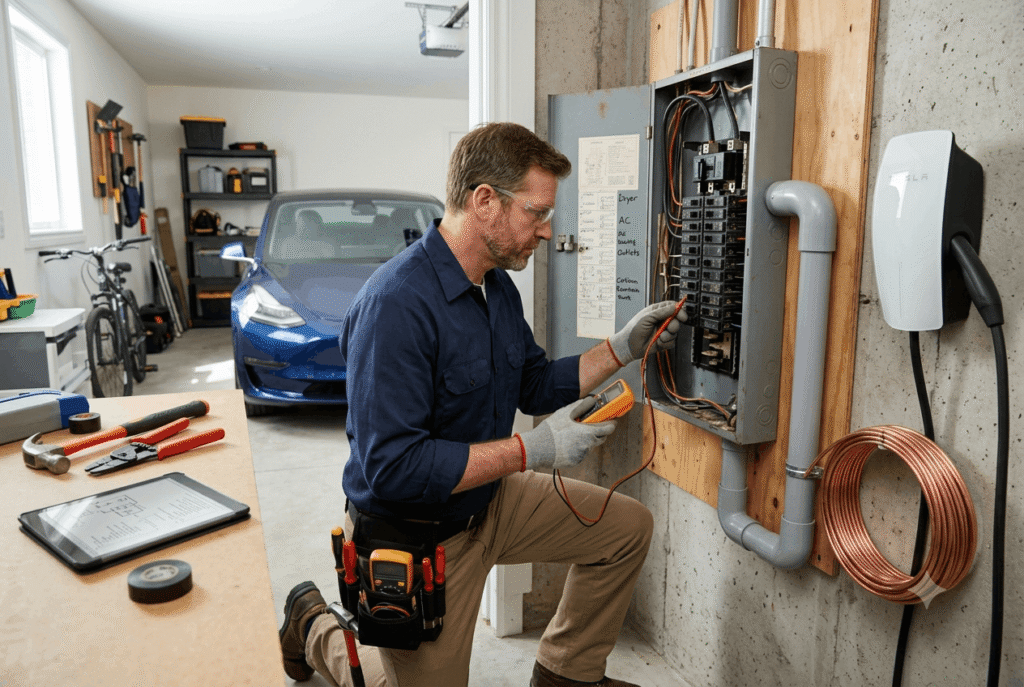

Homes across Toronto and the GTA were built to different electrical standards, so preparation before an EV charger installation varies by property. The scope of the work is set by the existing installation: the service size, the space available in the panel, and the distance to the charger location.
Do I need a permit for an EV charger in Ontario?
Residential charger work is generally filed with the Electrical Safety Authority and inspected.
Can I plug an EV into a regular outlet?
A standard 120 volt outlet supplies a low charging rate, so Level 2 equipment is common.
Will my panel need upgrading
That depends on the load calculation, and some 100 amp services have capacity available.
How long does installation take?
A simple installation is often completed within a day, while panel work or trenching adds time.
Why an Electrical Assessment Comes First
A Level 2 charger adds a significant continuous load, so a licensed electrician in Toronto confirms through a calculated load that the existing service can carry it.
An assessment generally reviews:
- The existing service size, commonly 60, 100, 125, or 200 amps
- Existing loads such as air conditioning, a dryer, a range, or a pool pump
- Available breaker spaces in the panel
- The wiring route from the panel to the parking position
- Whether load management could reduce the need for a service upgrade
Older Homes and Electrical Capacity Considerations
Fuse panels, 60 amp services, knob and tube wiring, and aluminum branch circuit wiring are present in some older properties. None of these in itself prevents an electric car charger installation. The condition of the installation and the scope of the new work determine what applies before a 240 volt circuit is added. Where panel space or service capacity is limited, the added load can contribute to nuisance breaker tripping. Where aluminum wiring is present, replacement or approved connection methods can improve the reliability of the terminations.
Panel Upgrades That May Support Future EV Charging Needs
Where the load calculation shows limited capacity, an electrical panel upgrade is one option. Larger services support more than the charger alone, although the capacity gained depends on the utility supply and the equipment selected.
Additional capacity can also make room for:
- A second vehicle and charger in future
- Heat pumps or electric heating
- Basement suite circuits
- Induction ranges, tankless water heaters, or a backup system
Garage, Driveway, and Outdoor Charger Locations
The charger location affects the wiring method and the length of the run. An attached garage next to the panel allows a shorter run, while a detached garage or driveway position can call for trenching or conduit.
Planning also confirms:
- Attached or detached garage
- Trenching or an overhead feed to a detached garage
- Enclosures rated for outdoor and wet locations
- Mounting height and cable reach
- Parking orientation
ESA Requirements for Residential Installations
In Ontario, residential EV charger work is generally notifiable. The contractor files with the Electrical Safety Authority, the installation follows the Ontario Electrical Safety Code, and an inspection is carried out. The steps that apply depend on the scope of the work and the requirements in effect. Canadian Wire Wizards holds an ECRA/ESA electrical contractor licence, and we file the notification for the work we perform.
Working With a Licensed Electrical Contractor in Toronto
Canadian Wire Wizards is a licensed electrical contracting company serving the GTA, established in 2018 and owned and operated by Demetrois Alafogiannis, with more than 35 years of combined industry experience.
Homeowners comparing contractors commonly confirm:
- The ECRA/ESA electrical contractor licence number
- Whether the ESA notification is included in the quotation
- Whether a load calculation has been performed
- The scope of the warranty on labour and parts
- Whether rebate or utility documentation is handled
Planning a Safe EV Charger Installation in Toronto
The scope of an EV charger installation in Toronto is set largely by the existing electrical system. A load calculation, available panel space, the wiring route, and the ESA notification together define the work involved.